The Hidden Cost of Ignoring Predictive Maintenance for Your Commercial Kitchen Appliances
When a commercial oven fails during a fully booked dinner service, the repair bill is only the beginning of the financial damage. Delayed orders, wasted ingredients, overtime, emergency service calls, and disappointed customers can turn one mechanical fault into an expensive operational setback. Predictive maintenance commercial kitchen strategies help food businesses identify warning signs before equipment failure interrupts production, allowing managers to plan interventions around actual operating conditions rather than waiting for something to break.
For restaurants, hotels, institutional kitchens, catering operations, and high-volume food production facilities, the objective is not to service every appliance constantly. It is to recognize which assets are most likely to disrupt service, understand what their condition is telling the team, and intervene when the expected benefit outweighs the cost. Combined with practical maintenance routines and commercial kitchen maintenance software, this approach can improve equipment availability, protect food quality, and support more predictable operating expenses.
The most useful starting point is a clear diagnosis of hidden maintenance costs, followed by no-cost improvements, a realistic assessment of monitoring tools, and disciplined criteria for deciding whether additional technology is worth the investment.
1. Diagnose the Hidden Costs Behind Commercial Kitchen Equipment Failures
Reactive maintenance is easy to understand: an appliance stops working, someone reports the fault, and a technician repairs it. The problem is that the business usually pays for more than the repair itself. In a busy kitchen, equipment is part of a connected production system. A single failure can affect preparation, cooking, holding, sanitation, delivery timing, and staff allocation.
Downtime costs more than the service invoice
Consider a high-capacity combi oven that becomes unavailable during a catering preparation window. Staff may need to redistribute batches across smaller ovens, change production sequences, or delay dispatch. If no suitable alternative exists, some orders may have to be reduced, substituted, or refunded.
The true cost includes direct and indirect losses:
- Emergency repair expenses: Urgent callouts, expedited parts, and work outside normal service hours can increase the immediate bill.
- Lost production capacity: The kitchen may prepare fewer meals per hour or miss a delivery deadline.
- Ingredient waste: Partially prepared food, spoiled inventory, and unusable batches can increase food costs.
- Labor disruption: Employees may wait for equipment, repeat work, move products between stations, or stay late to recover the schedule.
- Customer and contract risk: Repeated delays can weaken customer confidence and threaten catering agreements or service-level commitments.
- Secondary equipment strain: Overloading backup appliances can accelerate wear or expose existing weaknesses elsewhere in the kitchen.
Not every failure creates all these losses, and a minor fault during a quiet period may have little operational impact. The important distinction is between the price of repairing an appliance and the total business cost of losing its capacity at a critical moment.
Why high-capacity appliances deserve priority
Industrial dishwashers, walk-in refrigeration systems, high-output fryers, commercial ovens, blast chillers, and food processors can become production bottlenecks when unavailable. Their importance depends on the operation. A hotel serving several hundred meals may consider a main oven critical, while a beverage-focused business may depend more heavily on refrigeration and professional espresso equipment.
Managers should evaluate each asset according to three factors: the likelihood of failure, the consequence of failure, and the availability of a practical substitute. An appliance that is old but rarely used may deserve less attention than a newer machine that operates continuously and has no backup.
Calculate the cost of an interruption
A simple internal estimate makes maintenance decisions more objective. Suppose an appliance failure requires a $450 repair, causes $300 in wasted ingredients, adds $180 in labor, and creates $700 in estimated lost contribution margin. The illustrative total is $1,630, not merely the $450 repair invoice.
These figures are examples rather than industry benchmarks. A business should use its own invoices, payroll records, food-cost data, and sales contribution figures. Avoid counting the same loss twice: if lost sales are already calculated as contribution margin after variable costs, do not add those same variable costs again.
Once managers understand the full impact, the next question becomes more productive: which failures can be prevented, detected earlier, or handled with less disruption?
2. Start With No-Cost Maintenance Improvements Before Buying Technology
Predictive maintenance does not begin with a sensor installation or a software subscription. It begins with reliable operating information and consistent routines. Many kitchens can improve equipment reliability using existing staff, manufacturer documentation, maintenance logs, and a clearly assigned responsibility structure.
Establish a useful equipment baseline
Create an asset register for major appliances. Record the manufacturer, model, serial number, installation date if known, service contact, warranty status, operating hours where available, and maintenance history. Note the equipment's role in production and identify alternatives if it becomes unavailable.
Next, establish normal operating conditions. Depending on the appliance and manufacturer guidance, relevant observations might include refrigeration temperatures, oven preheat behavior, unusual vibration, recurring error codes, wash-cycle duration, or changes in energy consumption. A baseline is valuable because a meaningful change from normal behavior can be more informative than a single isolated reading.
Do not assume that every appliance exposes the same data. Some equipment provides electronic diagnostics and operating-hour records; other machines require manual observations and professional inspection. Use only measurements that can be collected consistently and interpreted correctly.
Make daily observations part of the work routine
Operators are often the first people to notice a developing problem. A fryer taking longer to recover temperature, a dishwasher leaving residue, or a refrigerator running more frequently than usual may indicate a maintenance issue. These signs are not proof of a specific fault, but they justify investigation before performance deteriorates further.
Build brief checks into opening, closing, and shift-handover procedures. Staff should report observable symptoms, not attempt repairs outside their training. Record the time, affected appliance, operating conditions, and whether the issue is recurring. A precise report such as "oven preheat has become noticeably slower over the past three shifts" is more useful than "oven not working properly."
Follow manufacturer-approved preventive tasks
Cleaning filters, clearing approved ventilation paths, inspecting accessible seals, and checking designated user-serviceable components can help maintain normal operation. However, tasks and intervals must follow the equipment manual, sanitation requirements, warranty conditions, and local safety rules.
Maintenance schedules should reflect operating intensity. An appliance running two shifts every day may need more frequent attention than an identical unit used occasionally. Food residue, grease, moisture, heat, hard water, and poor ventilation can also influence maintenance needs.
Do not treat cleaning as a substitute for technical diagnosis. A blocked filter may be straightforward to address, while repeated overheating, electrical faults, refrigerant problems, or abnormal motor behavior may require a qualified technician.
Use a simple failure log to find recurring patterns
Keep a record of symptoms, fault codes, repair dates, parts replaced, technician findings, downtime, and the conditions preceding each incident. After several entries, recurring patterns may become apparent. For example, the same error after heavy production periods could justify reviewing operating conditions, cleaning practices, or a component's service history.
This record also helps distinguish a genuine recurring fault from isolated operator error or a one-time external event. Without documented history, businesses risk repeatedly paying for the same diagnosis or replacing components without resolving the underlying cause.
3. Understand What Predictive Maintenance Actually Adds
Preventive and predictive maintenance are related, but they solve different problems. Preventive maintenance follows planned tasks or intervals. Predictive maintenance uses condition information, historical patterns, or diagnostic indicators to estimate when intervention may be needed. A mature operation often combines both approaches rather than choosing one exclusively.
The value of prediction is not simply knowing that a machine has a problem. It is having enough warning and confidence to choose a useful response. If an alert arrives after the appliance has already failed, the business may still benefit from better diagnosis, but it has not necessarily avoided the interruption.
Likewise, a scheduled inspection can be the better option for a low-cost, easily replaced component. Sophisticated monitoring is not automatically superior to a straightforward maintenance interval.
Match monitoring to the equipment's actual failure modes
Different appliances require different indicators. Refrigeration systems may benefit from temperature trends, alarm histories, compressor behavior, and door-seal inspections. Ovens may provide diagnostic codes, heating-cycle information, or fan-related alerts. Dishwashers may expose cycle data, temperature readings, and recurring wash-performance problems.
These signals must be interpreted in context. A refrigeration temperature change might reflect frequent door opening, a loading issue, a failed seal, or a mechanical problem. An alert should prompt a defined diagnostic process, not an automatic assumption that a particular component must be replaced.
Food safety remains a separate priority. A predictive maintenance system must never replace required temperature checks, approved food-safety procedures, or immediate corrective action when food may have been held outside safe conditions. Maintenance prediction is a support mechanism, not permission to delay a necessary response.
4. When Commercial Kitchen Maintenance Software Becomes Worthwhile
Spreadsheets and paper logs can be adequate for a small operation with a limited number of appliances and one person responsible for maintenance. As a business adds equipment, locations, shifts, contractors, and reporting requirements, keeping information consistent becomes harder. This is where commercial kitchen maintenance software can provide practical value.
Centralize maintenance information and responsibilities
A maintenance platform may combine equipment records, preventive schedules, work orders, fault reports, service histories, parts records, and technician assignments. Depending on the system, it may also connect to supported equipment telemetry, building-management systems, or external monitoring devices.
The immediate benefit is often better coordination rather than advanced prediction. A manager can see which inspections are overdue, which appliances have recurring faults, who owns an open work order, and whether a technician has documented the completed repair.
For a business managing several kitchens, consistent records can make it easier to compare recurring issues and identify assets that consume a disproportionate share of maintenance resources. A common process can also reduce dependence on one employee's memory or personal spreadsheet.
Separate basic maintenance tracking from predictive analytics
Not every maintenance application offers genuine predictive functionality. A digital calendar, automated reminder, and work-order dashboard are useful management tools, but they do not necessarily forecast equipment failure.
Before adopting a platform, establish which capabilities are actually needed:
- Asset management: Equipment identification, service history, manuals, warranties, and ownership.
- Work-order management: Fault reporting, task assignment, priority levels, completion records, and follow-up actions.
- Preventive scheduling: Recurring tasks based on time, usage, or manufacturer guidance.
- Condition monitoring: Collection of relevant readings, alerts, or supported diagnostic information.
- Predictive analysis: Evidence-based risk estimates or trend analysis that goes beyond simple reminders.
- Reporting: Downtime, repeat failures, maintenance expenditure, and overdue work presented in a form managers can act on.
For many kitchens, implementing the first three capabilities well is the most sensible starting point. Predictive analytics should follow when the business has enough reliable data and a clear operational reason to use it.
Measure whether the system changes decisions
Software creates value when it improves the timing, quality, or cost of maintenance decisions. A dashboard that produces many alerts but does not help staff identify the next action can create extra work without reducing downtime.
Track practical indicators before and after implementation. Useful measures include unplanned downtime hours, repeat faults, emergency callout expenditure, time from fault report to response, maintenance completion rates, and the proportion of work performed according to plan. For critical appliances, also track missed production targets associated with equipment failures.
Compare equivalent periods and account for changes in operating volume, seasonality, staffing, and equipment age. A busy holiday period cannot be compared fairly with a quiet month without adjusting for workload. If the platform increases administrative work but does not improve decisions or reliability, its configuration or overall business case needs reconsideration.
5. Decide Whether to Invest: Pre-Purchase Checks, Cost, and Value
The purpose of maintenance technology is to reduce avoidable operating losses, not to add another subscription to the budget. A disciplined pre-purchase assessment helps distinguish a real operational need from an appealing but unnecessary feature set.
Check the existing process before shopping
First, review the previous 6 to 12 months of repair invoices, equipment interruptions, and recurring faults if those records are available. Identify the appliances responsible for the greatest combination of downtime, repair expenditure, and business disruption.
Next, check whether those appliances already provide useful diagnostic information. Review manuals and ask the authorized service provider what the equipment can report, which data can be exported, and which faults can be detected reliably. If the equipment has no accessible telemetry, a software subscription alone cannot manufacture accurate machine-condition data.
Finally, test the quality of current records. If technicians do not consistently record failure causes or repair outcomes, predictive analysis may produce misleading conclusions. Improve the reporting process before paying for advanced analytics.
Use conditional decision rules instead of buying every feature
- If one appliance causes most of the disruption, prioritize its service history, manufacturer-approved diagnostics, and repair plan before deploying a kitchen-wide monitoring system.
- If the main problem is missed inspections, start with a dependable maintenance calendar and work-order process rather than predictive analytics.
- If several locations struggle to coordinate technicians, prioritize centralized asset records, assignments, escalation rules, and reporting.
- If a critical appliance provides reliable condition data and failures have high consequences, investigate whether monitoring can provide enough advance warning to justify its cost.
- If the equipment is inexpensive, easy to replace, and backed by a practical spare, a replacement strategy may be more economical than sophisticated monitoring.
- If the manufacturer requires specialized service tools or proprietary diagnostics, verify authorized access and compatibility before committing to third-party software.
These distinctions matter because maintenance needs vary substantially across businesses. A central production kitchen with several shifts may justify investment that would be excessive for a small cafe with limited equipment and low interruption costs.
Calculate total cost of ownership, not just the subscription
Include setup, hardware, sensors, installation, data integration, staff training, ongoing software charges, connectivity, calibration where required, and technical support. Consider whether the platform requires a minimum contract term or additional fees for multiple locations and users.
Then compare the expected annual cost with realistic avoidable losses. For illustration, suppose a kitchen experiences four disruptive incidents annually, with an average avoidable cost of $1,500 per incident. Its annual incident cost is $6,000. If a proposed maintenance program costs $2,400 annually and could credibly prevent or reduce $3,600 of those losses, the estimated net annual benefit is $1,200 before considering any additional implementation expense.
This is an illustrative scenario, not a promise of savings. The result depends on whether the system can detect the relevant failure modes, whether staff respond in time, and whether the estimated avoided losses are genuinely preventable.
A useful calculation is:
Net annual benefit = estimated avoided failure costs + other verified savings − total annual program cost.
Where a one-time setup cost exists, include it in the payback calculation and evaluate a reasonable period over which the equipment and software will remain useful. If the expected benefit is small or uncertain, a limited pilot on one or two critical assets may be preferable to a large commitment.
Choose measurable value over feature count
Before approving a purchase, define the outcome that would make the investment worthwhile. It might be fewer emergency callouts, less downtime on a critical oven, better completion of required maintenance, or faster resolution of recurring refrigeration faults.
Set a baseline, agree on the measurement period, and decide who will review results. If a pilot produces alerts without actionable lead time, or if the business cannot establish a credible reduction in losses, do not expand merely because the software offers additional features.
The best-value solution is the least complicated approach that reliably addresses the identified problem. That may be an improved manual process, a maintenance management platform, a condition-monitoring installation, or a combination of all three.
6. Use Maintenance Alerts Safely and Avoid False Confidence
Predictive maintenance has limitations. Sensors can drift, communications can fail, equipment data can be incomplete, and a previously unseen fault can occur without a clear warning. Historical patterns can also become less reliable after equipment modifications, changes in workload, or replacement of major components.
Warning: Never allow an automated maintenance alert to override food safety, electrical safety, or manufacturer instructions.
If refrigeration performance threatens safe food storage, an appliance shows signs of electrical damage, a machine overheats abnormally, or a safety device activates, follow the relevant shutdown, isolation, food-protection, and escalation procedures. Contact qualified service personnel where required. Do not keep operating unsafe equipment simply because software predicts a low failure risk.
Control false alarms and missed warnings
Excessive alerts can lead to alert fatigue, especially during busy service periods. Managers should define severity levels, notification recipients, response times, and escalation rules. Routine deviations can be logged for investigation, while safety-critical alarms must follow the appropriate immediate-response procedures.
False negatives also matter. An absence of warnings does not prove that equipment is healthy. Continue manufacturer-prescribed inspections and statutory checks, and investigate unusual behavior even when the monitoring platform reports normal status.
Protect data and clarify responsibilities
Connected equipment and maintenance applications can involve user accounts, operational records, network access, and vendor-managed data. Review access controls, account permissions, data export options, backup arrangements, software support commitments, and the process for retrieving records if a contract ends.
Confirm who is responsible for interpreting an alert, authorizing repairs, contacting service providers, and recording the outcome. If several teams assume another person will respond, the system may identify a problem without preventing the failure.
Training should explain what alerts mean, what they do not mean, and when staff must stop work or escalate a concern. Technicians should also document whether an alert led to a confirmed fault, an adjustment, or no action. That feedback can improve future maintenance decisions.
7. Practical Implementation Checklist for Food Businesses
A phased rollout makes predictive maintenance more manageable and limits unnecessary expenditure. Use this checklist to turn the strategy into a repeatable process.
- Identify the commercial appliances whose failure would most seriously interrupt production.
- Record equipment models, service histories, warranties, manuals, and available diagnostic capabilities.
- Estimate the full cost of representative failures, including downtime, waste, labor, and lost contribution margin.
- Assign responsibility for daily observations, fault reporting, maintenance scheduling, and escalation.
- Standardize manufacturer-approved cleaning, inspection, and preventive service routines.
- Document recurring symptoms, fault codes, repairs, component replacements, and downtime duration.
- Check whether existing equipment can provide useful condition data before buying additional sensors.
- Define the specific operational problem that maintenance software or predictive monitoring must solve.
- Verify compatibility, data access, support arrangements, security controls, and total ownership costs.
- Run a limited pilot with clear baseline measures and agreed success criteria.
- Review alerts and completed work regularly, adjusting thresholds and procedures where justified.
- Expand only when evidence shows that the approach improves reliability or reduces avoidable costs.
For an initial 90-day rollout, the first month can focus on asset records and baseline measurements. The second can introduce standardized reporting, preventive schedules, and response responsibilities. During the third, managers can review recurring faults and assess whether a targeted monitoring pilot is justified.
This timeline is a practical planning example rather than a universal requirement. Businesses with complex equipment, regulatory obligations, or urgent safety concerns may need a different schedule, including immediate action on existing hazards.
8. Frequently Asked Questions About Predictive Maintenance in Commercial Kitchens
What is predictive maintenance for commercial kitchen appliances?
Predictive maintenance uses equipment condition information, diagnostic indicators, operating trends, or historical failure patterns to identify when an appliance may need attention. The goal is to schedule appropriate intervention before a developing fault causes a major interruption. It complements preventive maintenance and does not eliminate unexpected failures.
How is predictive maintenance different from preventive maintenance?
Preventive maintenance follows planned intervals or usage-based schedules. Predictive maintenance uses evidence about the equipment's condition or failure risk to help determine when an intervention is appropriate. A commercial kitchen often benefits from both: scheduled inspections for known service requirements and condition-based investigation when warning signs appear.
Does every commercial kitchen need maintenance software?
No. A small kitchen with a few appliances, reliable maintenance records, and a clear inspection process may work effectively with a spreadsheet or paper-based system. Software becomes more valuable when multiple sites, technicians, recurring faults, complex schedules, or reporting requirements make manual coordination unreliable.
Can maintenance software predict every equipment failure?
No. Predictive accuracy depends on the appliance, available data, known failure modes, sensor quality, and analytical method. Sudden component failures and faults without detectable warning signs may not be predicted. Maintenance software should support inspections and professional diagnosis rather than replace them.
Which commercial appliances should be monitored first?
Start with equipment that combines high failure consequences, frequent operation, a history of recurring problems, and limited backup capacity. Depending on the operation, that might include a main production oven, refrigeration system, high-capacity dishwasher, or critical food-processing machine. A documented risk assessment is more useful than selecting appliances solely because they are expensive.
How can a kitchen estimate the return on investment?
Calculate current failure-related costs using repair invoices, downtime records, labor, wasted food, and realistic lost contribution margin. Estimate the portion that a proposed maintenance approach could actually avoid, then subtract software, hardware, training, integration, and service costs. Use conservative assumptions and validate them with a limited pilot whenever possible.
What should a business do before adding monitoring sensors?
Check the manufacturer's diagnostic options, the specific failure mode being targeted, sensor compatibility, installation requirements, data accuracy, and who will respond to alerts. If an existing diagnostic feature already provides sufficient information, extra hardware may not be necessary. If the relevant fault cannot be detected reliably, buying a sensor may create expense without meaningful protection.
Can predictive maintenance reduce food waste?
It can help reduce waste when early detection prevents a failure from compromising refrigeration, production schedules, or equipment performance. However, the benefit depends on the fault and the response time. Businesses must still follow food-safety monitoring requirements and discard or manage affected food according to applicable procedures.
9. Conclusion: Turn Equipment Reliability Into a Measurable Business Advantage
The hidden cost of ignoring predictive maintenance is the gap between a repair that appears affordable and an equipment failure that disrupts an entire service. Emergency invoices, lost production, food waste, overtime, and customer dissatisfaction can combine to make a seemingly isolated fault far more expensive than expected.
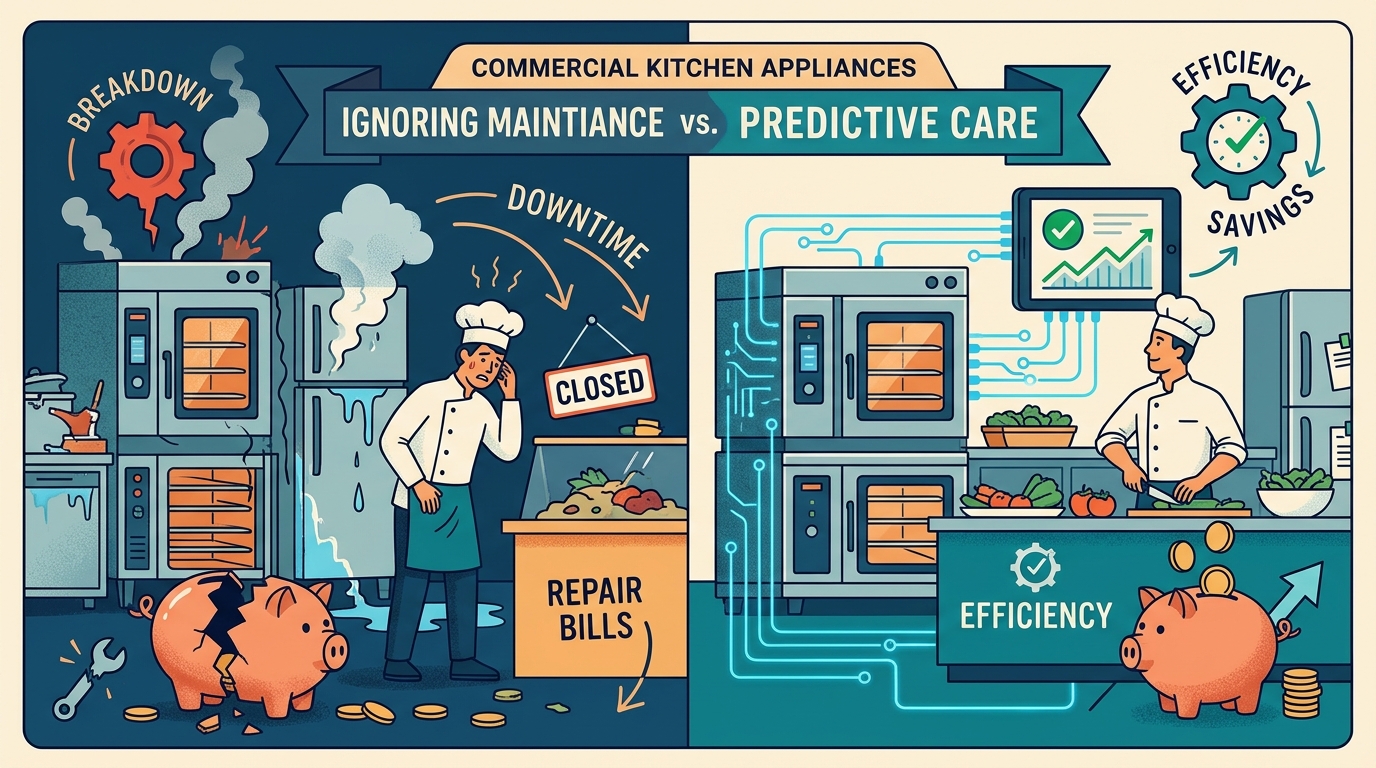
The most effective response is not to purchase the most sophisticated monitoring platform available. It is to build a reliable maintenance process around the equipment that matters most. Start by identifying critical assets, documenting recurring faults, following manufacturer-approved routines, and measuring the actual cost of downtime. Introduce commercial kitchen maintenance software when coordination, record quality, or reporting becomes a genuine operational challenge. Add predictive analytics when suitable data and demonstrable failure risks justify the additional investment.
Cost and value must remain central to every decision. A low-cost inspection may solve a problem that does not require technology. A well-maintained backup appliance may be more economical than installing sensors on a machine that is easy to replace. Conversely, a critical production asset with a history of costly interruptions may justify condition monitoring if it provides actionable warning and enough time to respond.
Ultimately, predictive maintenance commercial kitchen strategies succeed when they connect reliable information to clear decisions, timely repairs, and measurable operational outcomes. By reducing avoidable interruptions while preserving food safety and maintenance discipline, food businesses can protect productive capacity, extend useful equipment life where conditions allow, and make more informed decisions about long-term operating costs. The objective is not zero failures at any price. It is fewer costly surprises and a kitchen that can deliver consistent output when customers need it most.


Comments
Post a Comment