The Unseen Fallout: What Neglecting Preventative Maintenance Really Costs High-Capacity Commercial Kitchens
In a high-capacity commercial kitchen, equipment rarely fails at a convenient moment. A refrigeration unit struggles during a busy service, a combi oven develops inconsistent heating, or a commercial dishwasher stops completing cycles just as a large order arrives. These incidents are often treated as isolated breakdowns. In reality, they can be the visible consequences of months or even years of inadequate maintenance.
Commercial Kitchen Preventative Maintenance Costs extend far beyond the price of replacement components and scheduled technician visits. The financial consequences of neglect can include higher energy consumption, lost production hours, food waste, disrupted service, accelerated equipment deterioration, and increased workplace safety risks. For food businesses operating industrial cooking lines, central production kitchens, hotels, institutional catering facilities, and large restaurant operations, these indirect expenses can become more damaging than the original equipment problem.
The important distinction is between spending money to maintain equipment and losing money because equipment is no longer performing as intended. Preventative maintenance is not simply an administrative expense. It is a way of preserving operating capacity, protecting food quality, and managing the useful life of expensive commercial assets.
The Key Takeaway: A Small Maintenance Deferral Can Create a Much Larger Operational Expense
High-capacity kitchens depend on multiple interconnected systems working together. Refrigeration protects ingredients, cooking equipment determines production capacity, extraction systems manage heat and airborne contaminants, and warewashing equipment maintains sanitation standards. A problem in one area can affect the entire production sequence.
Consider a commercial kitchen preparing hundreds of meals during a concentrated service period. If a high-output oven becomes unavailable, staff may attempt to transfer its workload to other appliances. This can increase cooking times, create scheduling bottlenecks, and reduce the number of orders the kitchen can complete. If refrigeration is also operating inefficiently, staff may have fewer opportunities to safely reorganize ingredient storage.
The original fault may involve a relatively inexpensive component. However, the consequences can include overtime, delayed deliveries, canceled orders, discarded ingredients, and reduced customer confidence.
Three principles are particularly important:
- Maintenance protects capacity: An appliance that technically operates may still perform below its intended output.
- Maintenance protects predictability: Identifying deterioration before failure makes it easier to schedule repairs outside peak production periods.
- Maintenance protects asset value: Correct cleaning, inspection, adjustment, and servicing can reduce avoidable wear on expensive equipment.
Not every equipment problem can be prevented. Components eventually reach the end of their useful life, manufacturing defects occur, and unexpected electrical or mechanical faults can happen despite appropriate care. The objective is not to eliminate every breakdown. It is to reduce foreseeable failures and avoid allowing minor problems to develop into larger operational disruptions.
Why Neglected Maintenance Gradually Reduces Kitchen Efficiency
One of the most overlooked consequences of poor maintenance is declining efficiency. An appliance does not necessarily need to stop working before it begins costing a business money.
1. Refrigeration systems consume more resources when performance deteriorates
Commercial refrigerators and freezers operate continuously in demanding environments. Door seals, condenser coils, evaporator components, fans, drainage systems, and temperature controls all influence performance.
When condenser coils accumulate grease and dust, heat transfer can become less effective. The refrigeration system may need to operate for longer periods to maintain its required temperature. Damaged door gaskets can allow warm air to enter, increasing the cooling load and potentially contributing to condensation and ice formation.
The financial consequences are not limited to electricity consumption. Excessive operating strain can contribute to premature component wear, additional service requirements, and reduced refrigeration reliability.
There is also a food protection concern. A refrigeration unit displaying an apparently normal operating status does not automatically prove that every stored product has remained within the required temperature range. Businesses need appropriate temperature monitoring and documented food safety procedures rather than relying exclusively on an appliance display.
2. Cooking equipment can lose consistency before it loses functionality
Commercial ovens, grills, fryers, steamers, and induction systems depend on properly functioning heating elements, thermostats, sensors, burners, fans, and control systems.
A partially obstructed burner, inaccurate temperature sensor, or deteriorating heating element may cause inconsistent cooking performance. Staff may compensate by extending cooking times, changing operating settings, or repeating preparation steps.
These adjustments can create a hidden productivity penalty. Even when an appliance remains operational, it may no longer deliver the predictable output expected from its original specifications.
For a central production kitchen, inconsistency can also complicate batch scheduling. If different appliances produce different results under apparently identical settings, kitchen managers may need additional quality checks and more staff supervision.
3. Poorly maintained dishwashers create downstream bottlenecks
Commercial warewashing systems are essential to maintaining the circulation of clean utensils, trays, cookware, and food preparation equipment. Blocked filters, worn spray arms, incorrect chemical dosing, scale accumulation, and poorly maintained pumps can compromise cleaning performance.
A dishwasher that requires repeated cycles to achieve acceptable results consumes additional water, energy, chemicals, and staff time. More importantly, insufficient cleaning or sanitizing performance can create food safety concerns.
Maintenance should therefore address the complete washing process, including water quality, temperature verification, chemical dispensing, filtration, drainage, and manufacturer-specified operating procedures.
The Hidden Financial Consequences Beyond the Repair Invoice
When managers calculate the cost of equipment neglect, they often focus on the technician's invoice and replacement parts. That approach captures only a portion of the financial exposure.
A more realistic assessment considers the total operational impact of equipment deterioration.
These categories can overlap. For example, a malfunctioning refrigerator may increase electricity consumption before it causes a temperature excursion. If the problem remains unresolved, it may eventually lead to food losses and an emergency repair. Counting these as entirely independent events would exaggerate the financial impact, so managers should use actual operating records when estimating total costs.
The difference between direct and indirect maintenance expenses
Direct expenses are relatively easy to identify. They include labor charges, spare parts, inspections, replacement components, and scheduled servicing.
Indirect expenses are more difficult to measure. They include production delays, staff waiting time, excess energy consumption, rejected batches, additional cleaning, and reduced service capacity.
For a meaningful financial assessment, managers should compare the full cost of an equipment incident against the cost of maintaining the appliance under an appropriate service schedule.
A useful calculation is:
Total equipment failure cost = Repair expenditure + Production losses + Labor disruption + Product losses + Additional operating expenses.
This is an accounting framework rather than a universal industry formula. Businesses should avoid assigning arbitrary financial values to downtime or lost production without considering their actual margins, staffing structure, and operating conditions.
Why High-Capacity Equipment Requires a Different Maintenance Strategy
Industrial kitchen equipment operates under conditions that can be significantly more demanding than those encountered in domestic environments. High-volume production, extended operating hours, repeated thermal cycles, moisture, grease, cleaning chemicals, and continuous loading place considerable demands on mechanical and electrical components.
A commercial appliance designed for intensive use still requires maintenance. Its industrial construction does not make it immune to wear.
Continuous operation changes the maintenance equation
A refrigerator operating around the clock experiences a different duty cycle from a cooking appliance used intermittently. Likewise, a commercial dishwasher in a large institutional kitchen may process significantly more loads than a machine in a small restaurant.
Maintenance intervals should therefore reflect operating conditions rather than relying exclusively on a generic calendar reminder.
Relevant considerations include:
- Daily operating hours and production volume.
- Number of heating, cooling, and washing cycles.
- Ambient temperature and ventilation conditions.
- Water hardness and mineral accumulation.
- Grease, flour, dust, and airborne contamination.
- Manufacturer maintenance requirements and equipment age.
- Historical failure patterns and previous repair records.
Small component deterioration can affect an entire system
Industrial appliances often contain multiple interconnected components. A worn fan bearing can affect airflow. A failing temperature sensor can influence control behavior. A damaged seal can increase the workload placed on a refrigeration system.
This explains why replacing an individual component without investigating the underlying cause may produce only temporary improvement.
For example, repeatedly replacing a failed electrical component without checking for excessive heat, moisture intrusion, unstable electrical supply, or an associated mechanical fault can leave the original problem unresolved.
Professional diagnosis should examine the surrounding system and establish why the component failed before treating replacement as a complete solution.
The Safety Risks: When Maintenance Neglect Becomes a Food Protection Issue
Financial performance is important, but equipment maintenance also has a direct relationship with workplace safety and food protection.
High-capacity kitchens contain equipment involving electricity, gas, heat, steam, pressurized water, refrigeration systems, sharp mechanical components, and chemical cleaning products. Deterioration in any of these areas can create hazards.
Electrical and mechanical hazards
Damaged cables, deteriorating insulation, loose connections, water ingress, overheating, and malfunctioning protective devices can create electrical risks. Excessive vibration, damaged guards, and worn moving components can also expose workers to mechanical hazards.
Equipment should not remain in operation merely because it can still complete its basic function. A machine showing signs of electrical damage, unusual burning odors, exposed wiring, or repeated protective-device trips requires appropriate professional assessment.
Gas and heat-related hazards
Commercial gas cooking appliances require suitable combustion, ventilation, and safety controls. Incorrect burner operation, damaged connections, inadequate extraction, and faulty ignition systems should never be dismissed as minor inconveniences.
Similarly, damaged steam equipment, malfunctioning pressure controls, and deteriorating door seals can create risks of burns or uncontrolled release of hot vapor.
Food safety depends on reliable equipment performance
Refrigeration, cooking, holding, and warewashing equipment all contribute to food safety procedures. A malfunctioning unit can interfere with temperature control, cooking consistency, safe holding, or effective cleaning and sanitizing.
However, equipment maintenance alone does not guarantee food safety. Staff training, calibrated monitoring devices, documented procedures, proper food handling, and corrective actions remain essential.
WARNING: Do not treat a potentially dangerous equipment fault as a routine maintenance issue.
Stop using affected equipment when there are signs of electrical arcing, exposed live wiring, suspected gas leakage, uncontrolled overheating, abnormal pressure behavior, damaged safety guards, or other immediate hazards. Follow site emergency procedures, isolate the equipment only when safe and appropriate, and contact a qualified technician or emergency service as required.
Never bypass an interlock, protective device, temperature control, or other safety mechanism to keep production running. If food has potentially been exposed to unsafe temperatures or inadequate processing conditions, follow the applicable food safety assessment and disposal procedures.
Understanding the Limits of Preventative Maintenance
Preventative maintenance is valuable, but it should not be presented as a guarantee against equipment failure. An effective maintenance program reduces identifiable risks; it cannot eliminate every source of uncertainty.
This distinction matters when managers decide how much maintenance is appropriate and where resources should be allocated.
Maintenance cannot reverse every form of deterioration
Cleaning a condenser coil may improve heat transfer, but it cannot restore a compressor that has suffered serious internal damage. Replacing a worn gasket may improve a refrigerator's performance, but it will not correct a separate refrigerant-system fault.
Likewise, routine lubrication cannot indefinitely preserve bearings that have reached the end of their service life.
When an appliance repeatedly develops faults, managers should consider whether continued repairs remain technically and economically justified. Equipment condition, spare-part availability, repair history, energy performance, and operational importance should inform the decision.
Not every appliance needs the same inspection frequency
A lightly used preparation appliance does not necessarily require the same maintenance intensity as a continuously operated refrigeration system or a heavily loaded commercial dishwasher.
Applying an identical schedule to every machine may waste labor on low-risk assets while leaving critical equipment insufficiently monitored.
A better approach combines manufacturer recommendations with operational risk, usage intensity, environmental conditions, and recorded fault history.
When replacement may be more sensible than continued maintenance
There are circumstances in which repeated preventative work becomes uneconomical. If an older appliance experiences frequent major failures, consumes excessive energy, has discontinued components, or cannot reliably meet current production requirements, a replacement assessment may be appropriate.
However, age alone is not enough to justify disposal. A well-maintained older machine may remain dependable, while a relatively new appliance may require significant corrective work because of misuse, poor installation, or unsuitable operating conditions.
The appropriate decision depends on its remaining service potential, safety condition, total operating costs, and business-critical role.
How to Identify Early Warning Signs Before a Breakdown
One of the most practical ways to reduce unexpected disruption is to recognize performance changes before equipment becomes unavailable.
Kitchen employees often notice these changes during ordinary operations, making staff observations an important part of a preventative maintenance system.
These warning signs are indicators, not definitive diagnoses. For instance, higher electricity consumption may reflect increased production rather than equipment deterioration. Managers should compare energy use with operating hours, seasonal demand, and production volume before attributing the change to a fault.
The same principle applies to abnormal noise or temperature variation. A symptom can have multiple causes, and a qualified technician should establish the underlying problem where technical intervention is required.
Building a Practical Preventative Maintenance System
An effective maintenance program does not need to begin with complicated software or a large administrative department. It needs reliable equipment records, clear responsibilities, appropriate inspection intervals, and a process for escalating problems.
Step 1: Establish an equipment register
Record each significant appliance, including its manufacturer, model, serial number, installation date, location, operating purpose, and relevant service information.
Include industrial ovens, refrigeration units, blast chillers, fryers, food processors, dishwashers, extraction equipment, and other production-critical assets.
Assigning an equipment identification number makes it easier to connect inspection reports, repair invoices, spare-part records, and maintenance history.
Step 2: Classify equipment according to operational risk
Not all equipment failures have the same consequences. A failure affecting critical refrigeration or an essential cooking line may disrupt an entire production operation. A fault in a secondary appliance may be manageable through an alternative workflow.
Managers should consider food safety implications, production dependence, available backup capacity, repair lead times, and the consequences of temporary unavailability.
Step 3: Establish appropriate inspection routines
Separate routine operator observations from technical maintenance work.
Daily or shift-based checks may include visible damage, unusual sounds, cleanliness, operating indicators, and temperature records. Scheduled technical inspections may involve electrical testing, gas-system assessment, calibration, mechanical checks, and other manufacturer-specific procedures.
Only tasks permitted by the manufacturer and applicable workplace rules should be assigned to kitchen employees. Specialized electrical, gas, refrigeration, and pressure-system work belongs to appropriately qualified professionals.
Step 4: Maintain accurate service and repair records
Recording a repair without documenting the original symptoms or root cause limits its usefulness. A better service report identifies the affected equipment, reported fault, inspection findings, replaced components, completed work, and any outstanding recommendations.
Over time, these records help managers recognize recurring failures and determine whether an appliance needs more frequent inspection, a different repair strategy, or eventual replacement.
Step 5: Plan industrial appliance spare parts availability
Maintenance planning should include an assessment of spare-part lead times. A relatively simple component can cause extended downtime if the correct replacement is unavailable.
Common examples include door gaskets, filters, belts, seals, switches, sensors, and manufacturer-approved consumable components. However, critical parts should be identified from actual equipment failure history and manufacturer guidance rather than purchased indiscriminately.
Online marketplaces such as Amazon, eBay, and AliExpress may contain listings for general maintenance supplies, replacement accessories, and industrial appliance components. Their availability does not establish technical compatibility or suitability for commercial food-service equipment.
For instance, an Amazon listing for a general-purpose filter, an eBay listing for an appliance component, or an AliExpress listing for an electrical accessory should not be treated as proof that the item is approved for a specific machine. Managers should verify model compatibility, specifications, traceability, supplier credibility, and relevant safety requirements before authorizing procurement.
The same caution applies to other marketplace listings on Amazon, eBay, and AliExpress. Low purchase cost is not a meaningful saving if an unsuitable component creates additional failures, invalidates equipment protections, or compromises food safety.
Step 6: Review maintenance performance regularly
A maintenance schedule should be evaluated rather than simply followed indefinitely. Review recurring faults, emergency callouts, downtime, energy consumption, repair expenditure, and equipment availability.
If the same fault repeatedly returns, investigate whether the inspection interval is unsuitable, the original diagnosis was incomplete, or the equipment has reached a condition where replacement should be considered.
A Practical Maintenance Checklist for High-Capacity Kitchens
The following checklist provides a starting point for kitchen managers. It should be adapted to equipment manuals, site-specific risk assessments, and local regulatory requirements.
Daily and shift-based operational checks
- Confirm that refrigeration and freezer temperatures are monitored and recorded according to the food safety plan.
- Check refrigeration and freezer doors for damaged seals or obvious closing problems.
- Look for unusual noises, excessive vibration, visible leaks, or abnormal odors.
- Check cooking appliances for visible damage and irregular operating behavior.
- Inspect accessible dishwasher filters and remove debris according to manufacturer instructions.
- Confirm that extraction systems are operating as expected and that visible obstructions are reported.
- Record equipment faults and communicate them to the responsible manager.
Scheduled technical maintenance
- Arrange professional inspection of electrical connections and protective systems.
- Inspect gas equipment, ignition systems, and relevant safety controls through qualified personnel.
- Clean and inspect refrigeration heat exchangers and associated airflow paths.
- Assess door gaskets, hinges, fans, pumps, bearings, and mechanical assemblies.
- Verify relevant temperature controls and calibration requirements.
- Inspect dishwasher spray systems, dosing equipment, drainage, and water-quality considerations.
- Review extraction, ventilation, and grease-management maintenance requirements.
- Document replaced parts, service findings, and outstanding corrective actions.
Management-level checks
- Maintain an up-to-date equipment register.
- Review repair history and recurring faults.
- Identify equipment without a practical backup.
- Check spare-part availability for critical assets.
- Review maintenance expenditure alongside downtime and operational performance.
- Confirm that contractors have appropriate qualifications and insurance where required.
- Update maintenance priorities when production volumes or operating conditions change.
When Should a Business Arrange Maintenance? A Situation-Based Decision Framework
The most useful maintenance policy is one that helps managers decide what to do when different conditions arise. A rigid approach that treats every fault equally can either waste resources or delay necessary intervention.
The following thresholds provide a practical starting point.
Situation 1: Routine deterioration without an immediate safety concern
If an appliance shows minor changes such as gradually increasing operating noise, slower performance, or visible dirt accumulation, document the symptoms and assess the issue against manufacturer guidance.
If routine cleaning or an operator-level check is permitted, complete it and monitor the result. If the symptom persists, worsens, or affects performance, schedule a professional inspection rather than waiting for complete failure.
Situation 2: Repeated performance problems
If an appliance repeatedly fails to maintain its expected performance, even after previous repairs, escalate the issue for a root-cause assessment.
For example, if a refrigeration unit repeatedly struggles to maintain the required temperature, do not simply reset its controls each time. Verify food safety conditions, follow the site's corrective-action procedure, and arrange technical diagnosis.
If the same fault returns after multiple repairs, compare the cumulative repair costs and operational disruption against the cost and feasibility of replacement.
Situation 3: Critical equipment becomes unreliable
If an essential appliance has no practical backup and its deterioration threatens production capacity, give it higher maintenance priority than a noncritical machine.
For a central production kitchen, a primary blast chiller, refrigeration installation, or major cooking line may warrant urgent assessment because its failure can affect several production stages.
If the equipment cannot reliably perform its required function, reduce dependence on it and activate an approved contingency plan until the problem is resolved.
Situation 4: Immediate safety or food safety concerns
If there is suspected gas leakage, electrical damage, uncontrolled overheating, or another immediate hazard, stop using the affected equipment and follow emergency procedures.
If food safety controls have been compromised, evaluate affected products according to applicable procedures rather than assuming that the equipment can simply be restarted.
In these circumstances, restoring production is secondary to protecting workers and consumers.
Situation 5: The cost of maintaining an older appliance keeps increasing
If a machine experiences frequent significant faults, has limited parts availability, or cannot support current production requirements, conduct a lifecycle review.
If repair costs, downtime, energy consumption, and reliability concerns collectively outweigh the benefits of retaining the appliance, prepare a replacement business case. If the equipment remains dependable and can be supported safely, continued maintenance may still be the more economical choice.
Calculating the Business Value of Preventative Maintenance
Maintenance decisions become easier when managers connect engineering records with financial performance. Instead of asking only how much a service visit costs, ask how the service affects the total cost of operating the kitchen.
One useful management metric is equipment availability:
Equipment availability (%) = Operating time ÷ (Operating time + Downtime) × 100.
This provides a simplified view of how much scheduled operating time an appliance remains available. The business should define operating time and planned downtime consistently so that the metric is meaningful.
Another useful measure is the frequency of unplanned equipment failures. A rising number of emergency repairs may indicate that the existing maintenance approach is no longer adequate.
Managers can also compare maintenance expenditure with the value of avoided disruption, although avoided costs are estimates rather than directly observed savings.
For example, a business considering additional refrigeration servicing should examine:
- Recent repair frequency and associated expenditure.
- Recorded temperature deviations and corrective actions.
- Energy use relative to production demand.
- Potential food losses associated with equipment failure.
- Expected downtime if a critical component fails.
- Availability and lead time of replacement components.
The objective is to identify whether a more structured maintenance program improves reliability enough to justify its cost. The answer will vary between a small restaurant, a hotel kitchen, a hospital catering facility, and a large-scale food production operation.
Commercial Kitchen Equipment Lifecycle Management: Looking Beyond Individual Repairs
Preventative maintenance is only one part of effective equipment lifecycle management. Businesses also need a clear understanding of how equipment is installed, operated, serviced, upgraded, and eventually retired.
Lifecycle management begins before an appliance enters service. Correct installation, suitable utility connections, adequate ventilation, appropriate capacity, and staff training can all influence its long-term reliability.
During operation, documented maintenance helps establish whether an asset is performing as expected. Repair records also make it easier to identify recurring weaknesses and evaluate the cost of continued ownership.
As equipment ages, management should periodically assess:
- Its ability to meet current production requirements.
- Its safety and regulatory condition.
- Its energy and water consumption.
- The frequency and severity of corrective repairs.
- The availability of manufacturer-supported components.
- The financial implications of continued ownership.
Commercial kitchen maintenance services can support this process through scheduled inspections, condition assessments, technical diagnosis, repair planning, and service documentation. The value of a service provider should be assessed through the quality and completeness of its work, not simply the number of visits completed.
A useful maintenance arrangement should define the equipment covered, inspection responsibilities, response procedures, documentation standards, and escalation requirements. Critical appliances may also require contingency planning and agreed service response expectations.
For businesses with multiple sites, centralized maintenance records can provide additional value. Management can compare recurring equipment problems, standardize inspection procedures, monitor spare-part requirements, and identify assets that create disproportionate downtime.
Frequently Asked Questions About Commercial Kitchen Preventative Maintenance Costs
1. Why can neglected commercial kitchen maintenance become more expensive than scheduled servicing?
Neglected maintenance can allow minor deterioration to develop into major faults. The resulting expense may include emergency repairs, lost production, staff disruption, food waste, higher utility consumption, and premature equipment replacement. Scheduled maintenance creates a more predictable opportunity to identify and address problems before they become serious, although it cannot prevent every failure.
2. How frequently should high-capacity commercial kitchen equipment be serviced?
There is no single interval suitable for every appliance. Service frequency should follow manufacturer recommendations and consider operating hours, production volume, environmental conditions, equipment age, and previous faults. Continuously operated refrigeration and heavily used warewashing equipment may require different inspection schedules from intermittently used appliances.
3. Which commercial kitchen appliances should receive the highest maintenance priority?
Equipment should be prioritized according to safety implications, food protection requirements, production importance, and the availability of backup capacity. Critical refrigeration, primary cooking systems, essential ventilation, and major warewashing installations often deserve close attention. The exact priority depends on the operation's production process and risk assessment.
4. Can preventative maintenance reduce commercial kitchen energy consumption?
It can help reduce avoidable energy consumption associated with dirty heat exchangers, damaged seals, restricted airflow, poor calibration, and deteriorating components. However, actual savings depend on equipment condition, operating practices, production demand, and the underlying fault. Businesses should compare energy use against operating hours and output rather than assume every reduction is attributable to maintenance.
5. Is replacing a commercial appliance always better than repeatedly repairing it?
No. Replacement should be based on lifecycle economics rather than age alone. A reliable older appliance may remain economical to maintain, while a relatively new appliance may require replacement if it cannot be operated safely or economically. Consider repair frequency, component availability, energy performance, downtime, and remaining useful service life.
6. Can kitchen employees perform preventative maintenance themselves?
Employees can complete approved routine tasks such as visual inspections, permitted cleaning, accessible filter checks, and operational monitoring. However, electrical work, gas-system repairs, refrigeration-system interventions, pressure-system servicing, and other specialized procedures must be handled by appropriately qualified personnel. Staff should never bypass safety controls or attempt unauthorized repairs.
7. What should a commercial kitchen maintenance record include?
A useful record identifies the equipment, inspection date, operating condition, reported symptoms, findings, work completed, parts replaced, technician details, and outstanding corrective actions. Maintaining consistent records helps managers identify recurring failures, evaluate expenditure, and plan future equipment replacement.
8. Does preventative maintenance guarantee that commercial kitchen equipment will not break down?
No. Components can fail unexpectedly because of manufacturing defects, electrical disturbances, unusual operating conditions, or normal end-of-life deterioration. Preventative maintenance reduces foreseeable risks and improves fault detection, but businesses still need contingency arrangements, emergency response procedures, and appropriate spare-parts planning.
Conclusion: The Real Cost of Neglect Is the Capacity a Kitchen Can No Longer Deliver
The financial consequences of neglected equipment maintenance cannot be understood through repair invoices alone. High-capacity commercial kitchens depend on reliable refrigeration, consistent cooking performance, effective ventilation, dependable warewashing, and safe production processes. When these systems deteriorate, the consequences extend across labor productivity, energy use, food protection, service quality, and equipment lifespan.
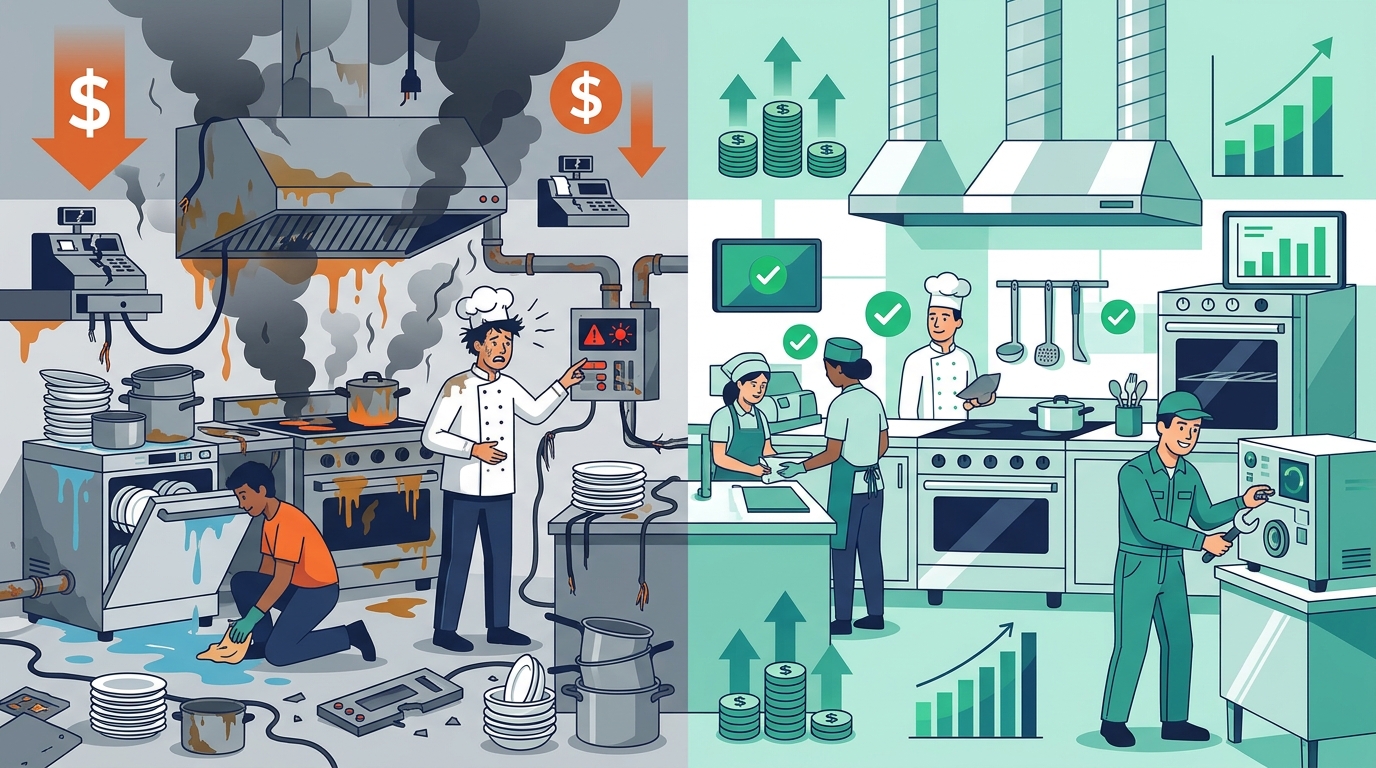
The most important management lesson is that equipment failure is not always the beginning of a problem. It is often the point at which an existing problem finally becomes impossible to ignore.
Commercial Kitchen Preventative Maintenance Costs should therefore be evaluated as part of a broader operational and lifecycle strategy. Businesses need to distinguish routine servicing from corrective repairs, measure the financial effects of downtime, identify early warning signs, and prioritize equipment according to operational risk.
That does not mean every appliance needs the most intensive service schedule or that every aging machine should immediately be replaced. Good maintenance management requires proportionate decisions. A low-risk appliance with stable performance may need only manufacturer-recommended routine attention, while an unreliable refrigeration installation or essential production system may justify more frequent professional assessment and a documented contingency plan.
Ultimately, the strongest maintenance strategy combines three elements: reliable equipment information, timely technical intervention, and management decisions based on actual operating conditions. Commercial kitchen maintenance services, properly controlled industrial appliance spare parts, and disciplined commercial kitchen equipment lifecycle management all contribute to this approach.
The real objective is not simply to keep machines running for as long as possible. It is to preserve safe, dependable, and economically sustainable production capacity throughout their useful working lives. When maintenance is treated as an integral part of kitchen operations rather than an expense to postpone, businesses are better positioned to protect their people, their products, their equipment, and the consistency their customers expect.


Comments
Post a Comment